
RHCES Spreadsheets

Spreadsheets that do the work.

Buy in one click, pay by GCash, Maya, QR Ph or PayPal, and your download appears as soon as the payment clears.

All products are non-refundable. Please check the details and price before you pay.
Licensed to the buyer only (one engineer or office). Sharing, uploading or reselling a product, or forwarding its download link, without the written permission of RHCES is prohibited. By buying you agree to our Terms of Service.

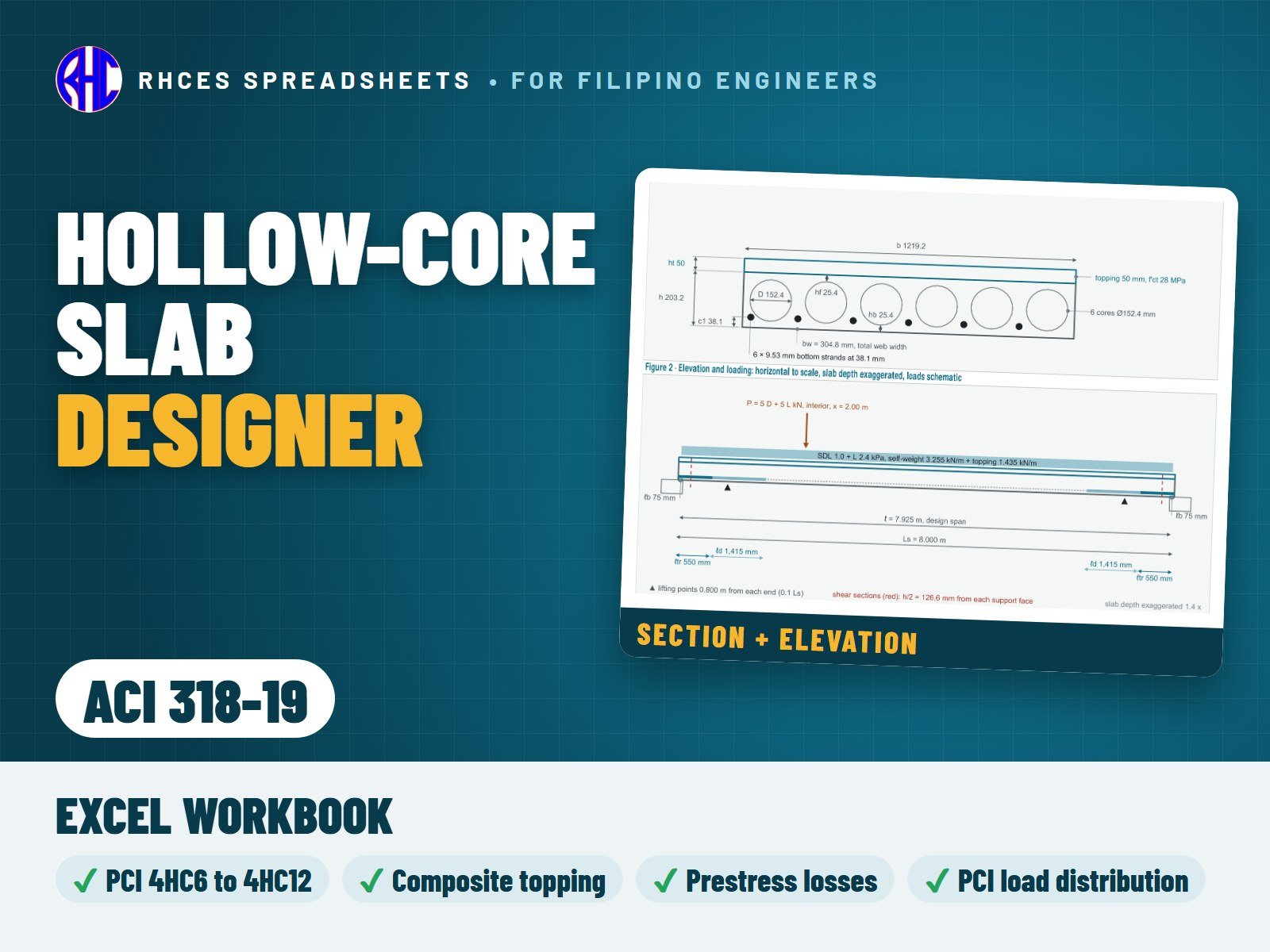
Preview of Hollow-Core Slab Designer (ACI 318-19)
Prestressed

Hollow-Core Slab Designer (ACI 318-19)

Design one precast, pretensioned hollow-core slab unit, simply supported, with straight bonded strands, untopped or with an unshored composite topping, by ACI 318-19 (SI units) and the PCI methods. Pick a PCI generic section (4HC6, 4HC8, 4HC10 or 4HC12) from the library, type a circular-core section, or enter your producer's section data. One layer of bottom strands and optional top strands, normalweight concrete, uniform loads, a transverse line load (a wall across the span), a concentrated load and a longitudinal line load (a wall along the span) with the PCI load distribution.

Checks: prestress losses by the PCI method; stresses at transfer, at service and in handling; flexural strength by strain compatibility or the ACI approximate equation, with the compression block through the topping, the top flange and the cores; strand development and the design strength along the span; shear strength Vci and Vcw at 45 stations with the prestress reduced in the transfer zone (dry-cast units carry no stirrups) and the hollow-core shear rule; horizontal shear of the topping; camber, long-term position and deflections; bearing and cover.

Two live figures redraw from your inputs: the cross-section with its dimensions, strands and cores, and the elevation with the loads, bearings, transfer and development zones, lifting points and shear sections. The Design Check Summary lists every check with its ratio and status and ends in one overall result: HOLLOW-CORE SLAB ADEQUATE, ADEQUATE · SEE CHECKS, REVISE THE SLAB or INCOMPLETE DATA. Not covered: continuous or cantilevered slabs, debonded strands, mild bars in the cores, filled cores, openings and notches, diaphragm action, fire rating, lightweight concrete, vibration, ASD, Class C (cracked) design and load tables. The PCI generic sections are for preliminary design: use your producer's section and strand positions for the final design. The Read Me lists the items worth confirming.

References: ACI 318-19 in SI (ACI 318M-19) for strength, serviceability and detailing; PCI MNL-126-98 (2nd ed.) for losses, camber, composite design and load distribution; PCI Design Handbook 7th edition for the generic sections and the handling multipliers, with the printed page of each reference shown in the workbook. NSCP 2015 is not included in this edition. The method was checked against the worked examples of PCI MNL-126-98 (losses, stresses, flexural and shear strength, camber and deflection).

Every result is a visible Excel formula with ACI 318-19 section references. Includes the Excel workbook. View sample on the store page previews a worked A4 sample calculation (an office floor slab, 4HC8 with a 50 mm topping, six 9.53 mm strands, slab length 8.0 m). One licence per engineer or office.
Excel · Slab Input, Prestress, Strength, Camber & Deflection and Summary sheets (A4); View sample: 9 pages
₱449.00View sample
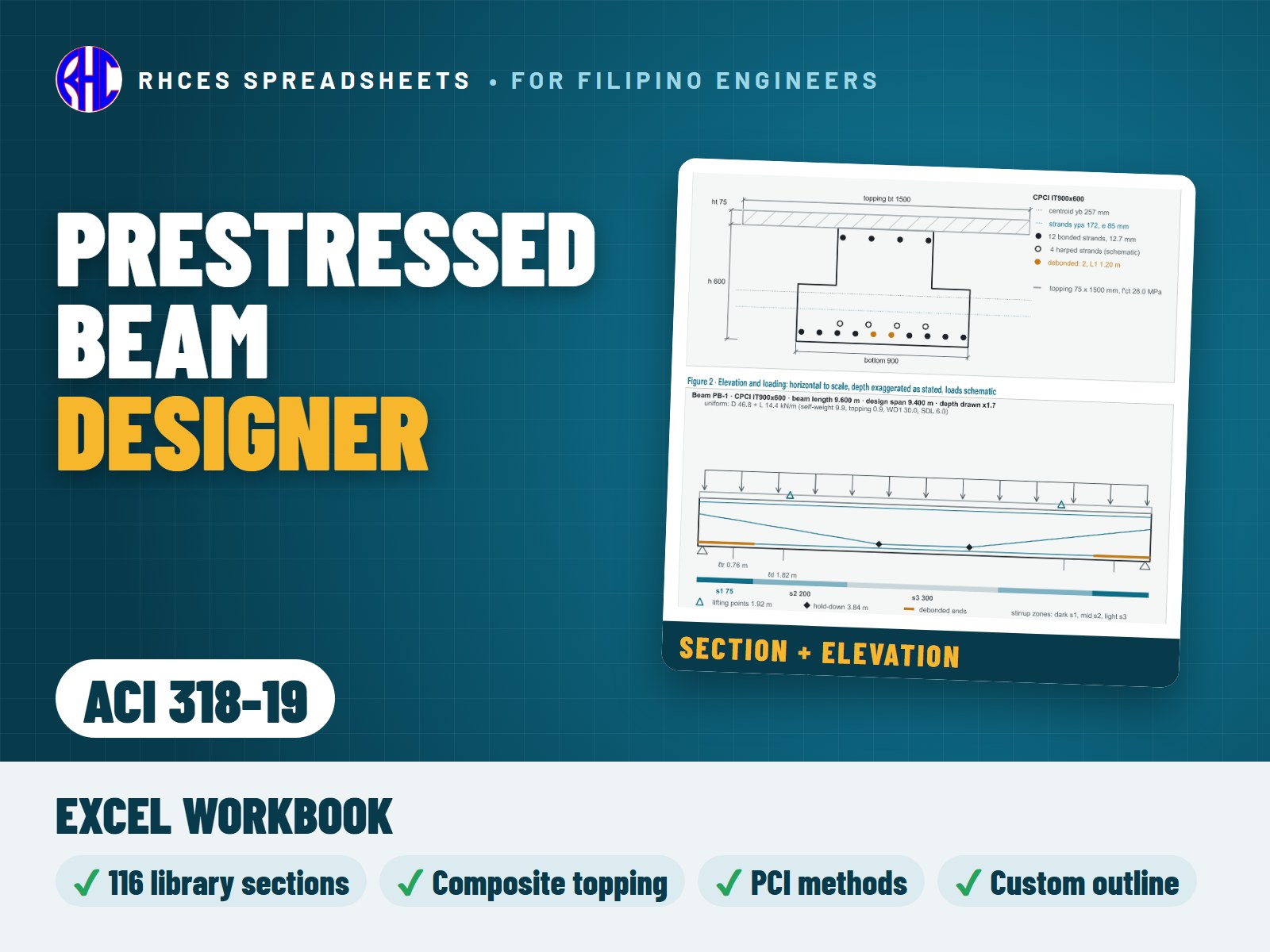
Preview of Prestressed Beam Designer (ACI 318-19)
Prestressed

Prestressed Beam Designer (ACI 318-19)

Design one precast, pretensioned, simply supported concrete beam by ACI 318-19 (SI) and the PCI methods, with or without an unshored composite topping. Pick the section from the library (116 sections: rectangular beams, L-beams, inverted tees and double tees of the PCI Design Handbook 7th ed., CPCI inverted tees and I-girders, AASHTO Types I to VI and PCI bulb tees) or type a custom outline (rectangular, I, T or inverted-T, L-beam, double tee or box). Every library section is computed from its dimensions and agrees with the published area and moment of inertia within 0.5 %. Generic sections are for preliminary design: use your producer's section for the final design.

Strands: Grade 1860 low-relaxation strand in up to 6 rows, each straight or harped, with debonded strands of up to two lengths; optional bottom and top mild bars; stirrups in three zones.

Checks: prestress losses by the PCI method (or your typed total loss); stresses at transfer, in handling and at service (Class U, or Class T if you accept it); flexural strength by strain compatibility along the span, with the transfer and development of every strand group; minimum strength 1.2 Mcr; shear Vci and Vcw along the span with the stirrup zones, minimum shear reinforcement, maximum spacing and the section limit; horizontal shear of the topping; end-zone (bursting) steel; bearing; cover; camber and deflections with the PCI multipliers. New in v1.1: when handling tension is above fr/1.5, the workbook shows the top steel required to carry it and checks the bars you provide. Four drawings redraw from your inputs: the section with its strands, the elevation with the strand profile, loads and stirrup zones, the stress diagrams, and the moment and shear diagrams against the design strength. The Design Check Summary collects every check under one overall result: PRESTRESSED BEAM ADEQUATE, ADEQUATE · SEE CHECKS, REVISE THE BEAM or INCOMPLETE DATA — SEE CHECKS.

Not covered: post-tensioning (use the RHCES Post-Tensioned Beam Designer), continuous or cantilevered beams, shored construction, lightweight concrete, torsion (spandrel beams), the design of ledges, hangers and dapped ends (use the RHCES Corbel and Dapped-End designers), bridge girders by AASHTO LRFD, fire rating, seismic frame design, vibration and Class C (cracked) design.

References: ACI 318M-19; PCI Design Handbook 7th ed.; PCI MNL-126-98; CPCI Design Manual; Dolan and Hamilton, Prestressed Concrete (2019), with the printed page of each reference shown in the workbook.

The method was checked against 133 published values from the worked examples of the PCI Design Handbook, MNL-126 and Dolan and Hamilton (losses, stresses, flexure, debonded strands, end zone, shear, horizontal shear, camber and deflection), and every number was compared with a second, independent calculation.

Every result is a visible Excel formula. Includes the Excel workbook. View sample on the store page previews a worked A4 sample calculation (13 pages: office floor beam, CPCI IT900x600 inverted tee, 9.6 m long, 75 mm composite topping, 18 strands of 12.7 mm (straight, harped and debonded); result PRESTRESSED BEAM ADEQUATE, governed by the service tension at the bottom, ratio 0.91). The sample is illustrative. One licence per engineer or office.

Excel · Beam Input, Prestress, Strength, Camber and Summary sheets (A4); View sample: 13 pages
₱449.00View sample
1Click Buy now
2Pay by GCash, Maya or QR Ph on PayMongo’s secure page, or with PayPal
3Your Download button appears as soon as payment clears